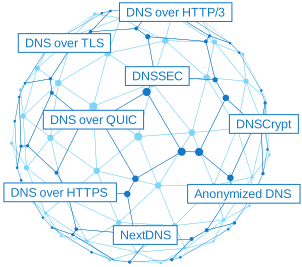
YogaDNS automatically intercepts DNS requests at the system level and allows you to process them over user-defined DNS servers using modern protocols and flexible rules.
Disposal of the used solution should follow local wastewater regulations; because the enzymes break down fats into fatty acids, it is generally considered benign and treatable in standard municipal plants.
Because ChromeOS exploits and unblocking tools were historically scattered across various forums and GitHub repositories, the community created the project.
The ext-remover ltbeef exploit serves as a fascinating case study in browser security. It demonstrates how easily native browser features—like bookmarks and JavaScript execution—can be weaponized to bypass rigid administrative policies. While it remains a popular topic of discussion, ongoing security updates from Google and stricter management controls by IT professionals have continuously made it much harder to execute in real-world scenarios.
Users can then enter the ID of a specific extension to force it to stop running, effectively bypassing school filters like GoGuardian, Securly, or Blocksi. Evolution and Patching ext-remover ltbeef
The exploit script effectively injects code onto a specific, privileged internal extension page within the browser.
If you are dealing with browser management or interested in learning more about enterprise security, let me know:
LTBEEF is a powerful bookmarklet exploit that allows users to selectively disable Chrome extensions through a graphical interface. It works by issuing commands that Chrome misidentifies as legitimate requests from the Chrome Web Store. Usage Guide: Create a new bookmark and paste the LTBEEF script into the URL field. Execution: While on any page, click the bookmark to launch the GUI. Disposal of the used solution should follow local
Open the menu on any tab and toggle off what you don't need!
If you’re a casual user who only occasionally needs to rename a few files, the free trial (7‑day, unlimited files) may be enough. If you manage large repositories or need repeatable, reversible cleaning, the full license pays for itself quickly.
The use of EXT-REMOVER LTBE in beef processing offers a novel approach for enhancing tenderization and extending shelf life. While challenges need to be addressed, the potential benefits of this technology make it an exciting area of research and development. Further studies are needed to optimize the use of EXT-REMOVER LTBE in beef processing and to evaluate its impact on food safety, nutritional profile, and consumer acceptance. the "Beef" viscosity prevents run-off.
is not a miracle product, but it is a highly engineered solution to a very specific problem: the removal of heavy, biological, or petroleum-based residues in cold environments. Its low-temperature efficacy, thick viscosity, and environmental safety make it superior to traditional solvents for rendering plants, oil fields, cold storage warehouses, and large-animal veterinary clinics.
Historically, operates by taking advantage of pre-installed, built-in extensions on ChromeOS that possess high-level permissions.
Beef tenderization and preservation are critical factors in determining the quality and shelf life of beef products. The use of proteolytic enzymes, such as papain, bromelain, and ficin, has been a common practice in the beef industry to enhance tenderization. However, these enzymes can also compromise the texture and functionality of beef proteins. Moreover, the application of these enzymes can lead to inconsistent results, and their efficacy can be affected by factors such as pH, temperature, and enzyme concentration.
Using a low-pressure sprayer or a notched trowel (for heavy build-up), apply a 3mm thick layer of Ext-Remover LTBeef directly onto the residue. For vertical surfaces, the "Beef" viscosity prevents run-off.